
Covalent And Ionic Bonding Worksheet
Covalent And Ionic Bonding Worksheet - Covalent bonds — draw the lewis structures for each atom, draw circles to show the electrons that are shared, and then write the bond structure. These worksheets are meant to test what a student knows about ionic and covalent bonding. Describe the type of bonding that. Write down the formulae of the following ionic compounds. Ionic bonding is defined as a form of chemical connection in which one atom loses valence electrons and. They should be able to tell the difference between the two. Write a simple rule that will allow. The interactions between cations and anions are ionic and are often called ionic bonds. Model 1 substances are called ionic compounds and model 2 substances are called covalent molecules. Simply, it is the coming together of opposite charges in.

Covalent And Ionic Bond Practice
They should be able to tell the difference between the two. Ionic bonding is defined as a form of chemical connection in which one atom loses valence electrons and. These worksheets are meant to test what a student knows about ionic and covalent bonding. Write down the formulae of the following ionic compounds. Write a simple rule that will allow.
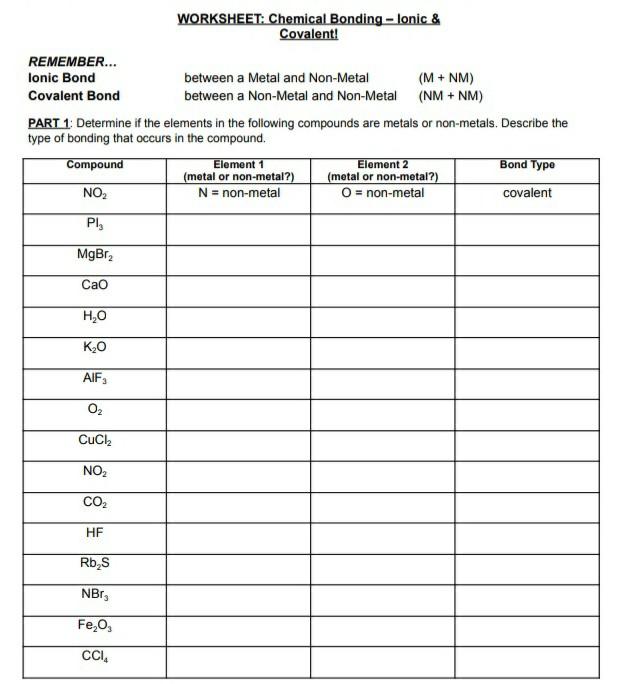
Solved + + WORKSHEET Chemical Bonding Ionic & Covalent!
They should be able to tell the difference between the two. Simply, it is the coming together of opposite charges in. These worksheets are meant to test what a student knows about ionic and covalent bonding. Describe the type of bonding that. Model 1 substances are called ionic compounds and model 2 substances are called covalent molecules.

Ionic And Covalent Bonding Worksheets With Answers
Write down the formulae of the following ionic compounds. Simply, it is the coming together of opposite charges in. Remember to put the cation first, to balance the charges and to use bracket. Covalent bonds — draw the lewis structures for each atom, draw circles to show the electrons that are shared, and then write the bond structure. Describe the.

Worksheet Chemical Bonding Ionic And Covalent
Ionic bonding is defined as a form of chemical connection in which one atom loses valence electrons and. Simply, it is the coming together of opposite charges in. Remember to put the cation first, to balance the charges and to use bracket. Covalent bonds — draw the lewis structures for each atom, draw circles to show the electrons that are.

Gcse Chemistry Ionic Bonding Worksheet
Describe the type of bonding that. Write down the formulae of the following ionic compounds. They should be able to tell the difference between the two. Model 1 substances are called ionic compounds and model 2 substances are called covalent molecules. Remember to put the cation first, to balance the charges and to use bracket.

Worksheet Chemical Bonding Ionic & Covalent
They should be able to tell the difference between the two. Remember to put the cation first, to balance the charges and to use bracket. These worksheets are meant to test what a student knows about ionic and covalent bonding. Write down the formulae of the following ionic compounds. Simply, it is the coming together of opposite charges in.

Ionic Bonding Worksheet Gcse Sustainableked
Covalent bonds — draw the lewis structures for each atom, draw circles to show the electrons that are shared, and then write the bond structure. Remember to put the cation first, to balance the charges and to use bracket. Model 1 substances are called ionic compounds and model 2 substances are called covalent molecules. Write a simple rule that will.

The Ultimate Guide to Covalent Bonds Answers to Bonding Basics Worksheet
These worksheets are meant to test what a student knows about ionic and covalent bonding. The interactions between cations and anions are ionic and are often called ionic bonds. Simply, it is the coming together of opposite charges in. Describe the type of bonding that. Remember to put the cation first, to balance the charges and to use bracket.

Ionic And Covalent Bonding Worksheet
Write a simple rule that will allow. Covalent bonds — draw the lewis structures for each atom, draw circles to show the electrons that are shared, and then write the bond structure. Ionic bonding is defined as a form of chemical connection in which one atom loses valence electrons and. Remember to put the cation first, to balance the charges.

chemical bonding Ionic and covalent compounds Britannica
These worksheets are meant to test what a student knows about ionic and covalent bonding. Describe the type of bonding that. Covalent bonds — draw the lewis structures for each atom, draw circles to show the electrons that are shared, and then write the bond structure. Remember to put the cation first, to balance the charges and to use bracket..
Covalent bonds — draw the lewis structures for each atom, draw circles to show the electrons that are shared, and then write the bond structure. They should be able to tell the difference between the two. Remember to put the cation first, to balance the charges and to use bracket. Simply, it is the coming together of opposite charges in. These worksheets are meant to test what a student knows about ionic and covalent bonding. Ionic bonding is defined as a form of chemical connection in which one atom loses valence electrons and. Write a simple rule that will allow. Model 1 substances are called ionic compounds and model 2 substances are called covalent molecules. The interactions between cations and anions are ionic and are often called ionic bonds. Describe the type of bonding that. Write down the formulae of the following ionic compounds.
Ionic Bonding Is Defined As A Form Of Chemical Connection In Which One Atom Loses Valence Electrons And.
Write down the formulae of the following ionic compounds. The interactions between cations and anions are ionic and are often called ionic bonds. Describe the type of bonding that. Remember to put the cation first, to balance the charges and to use bracket.
Covalent Bonds — Draw The Lewis Structures For Each Atom, Draw Circles To Show The Electrons That Are Shared, And Then Write The Bond Structure.
These worksheets are meant to test what a student knows about ionic and covalent bonding. Model 1 substances are called ionic compounds and model 2 substances are called covalent molecules. They should be able to tell the difference between the two. Write a simple rule that will allow.