
Blood Spatter Angle Of Impact Worksheet
Blood Spatter Angle Of Impact Worksheet - Use the space below to draw the approximate shapes of blood at 90°, 45°, 30°, and 10°. Identify the mechanisms by which blood spatter patterns are created. • what efect does the surface have on the diameter and shape of bloodstains? Use the scale to convert. Distance (d) measure the distance (cm) from the back stain to the aoc. Determine the ‘angle of impact’ for each bloodstain. 6 7 8 for the following blood drops, measure the length and width of the drop, and then calculate.

PPT Blood splatter analysis PowerPoint Presentation, free download
Use the scale to convert. Identify the mechanisms by which blood spatter patterns are created. 6 7 8 for the following blood drops, measure the length and width of the drop, and then calculate. Determine the ‘angle of impact’ for each bloodstain. Distance (d) measure the distance (cm) from the back stain to the aoc.

(5) Aspect 1 Angle of Impact. In Blood Spatter Analysis, finding the
Identify the mechanisms by which blood spatter patterns are created. Distance (d) measure the distance (cm) from the back stain to the aoc. Use the scale to convert. Use the space below to draw the approximate shapes of blood at 90°, 45°, 30°, and 10°. Determine the ‘angle of impact’ for each bloodstain.

BLOOD SPATTER ANALYSIS Lab
Determine the ‘angle of impact’ for each bloodstain. 6 7 8 for the following blood drops, measure the length and width of the drop, and then calculate. Use the scale to convert. • what efect does the surface have on the diameter and shape of bloodstains? Distance (d) measure the distance (cm) from the back stain to the aoc.

Bloodstain Patterns
• what efect does the surface have on the diameter and shape of bloodstains? Identify the mechanisms by which blood spatter patterns are created. 6 7 8 for the following blood drops, measure the length and width of the drop, and then calculate. Determine the ‘angle of impact’ for each bloodstain. Distance (d) measure the distance (cm) from the back.
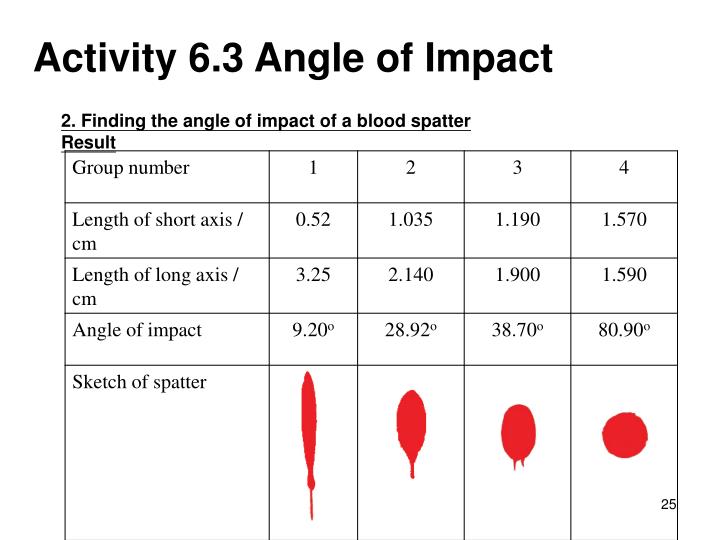
PPT Lesson 6 Blood Spatter Analysis PowerPoint Presentation ID840729
Distance (d) measure the distance (cm) from the back stain to the aoc. Use the space below to draw the approximate shapes of blood at 90°, 45°, 30°, and 10°. • what efect does the surface have on the diameter and shape of bloodstains? 6 7 8 for the following blood drops, measure the length and width of the drop,.

PPT Lesson 6 Blood Spatter Analysis PowerPoint Presentation, free
6 7 8 for the following blood drops, measure the length and width of the drop, and then calculate. Use the scale to convert. • what efect does the surface have on the diameter and shape of bloodstains? Distance (d) measure the distance (cm) from the back stain to the aoc. Determine the ‘angle of impact’ for each bloodstain.

Angle Of Impact Blood Spatter Worksheet
6 7 8 for the following blood drops, measure the length and width of the drop, and then calculate. Use the scale to convert. Distance (d) measure the distance (cm) from the back stain to the aoc. • what efect does the surface have on the diameter and shape of bloodstains? Determine the ‘angle of impact’ for each bloodstain.

Angle Of Impact Blood Spatter Worksheet
Distance (d) measure the distance (cm) from the back stain to the aoc. 6 7 8 for the following blood drops, measure the length and width of the drop, and then calculate. Identify the mechanisms by which blood spatter patterns are created. Use the scale to convert. • what efect does the surface have on the diameter and shape of.

Angle Of Impact Blood Spatter Worksheet
Use the scale to convert. Determine the ‘angle of impact’ for each bloodstain. 6 7 8 for the following blood drops, measure the length and width of the drop, and then calculate. Identify the mechanisms by which blood spatter patterns are created. • what efect does the surface have on the diameter and shape of bloodstains?

PPT Lesson 6 Blood Spatter Analysis PowerPoint Presentation ID840729
Use the space below to draw the approximate shapes of blood at 90°, 45°, 30°, and 10°. Use the scale to convert. Determine the ‘angle of impact’ for each bloodstain. Distance (d) measure the distance (cm) from the back stain to the aoc. • what efect does the surface have on the diameter and shape of bloodstains?
• what efect does the surface have on the diameter and shape of bloodstains? Identify the mechanisms by which blood spatter patterns are created. Use the space below to draw the approximate shapes of blood at 90°, 45°, 30°, and 10°. 6 7 8 for the following blood drops, measure the length and width of the drop, and then calculate. Determine the ‘angle of impact’ for each bloodstain. Distance (d) measure the distance (cm) from the back stain to the aoc. Use the scale to convert.
Use The Space Below To Draw The Approximate Shapes Of Blood At 90°, 45°, 30°, And 10°.
• what efect does the surface have on the diameter and shape of bloodstains? Identify the mechanisms by which blood spatter patterns are created. Distance (d) measure the distance (cm) from the back stain to the aoc. 6 7 8 for the following blood drops, measure the length and width of the drop, and then calculate.
Determine The ‘Angle Of Impact’ For Each Bloodstain.
Use the scale to convert.